Review by Sophia Matz
Trophy Boys: Show it in Schools
The Maybe Pile and Soft Tread Enterprises
Canberra Theatre Centre
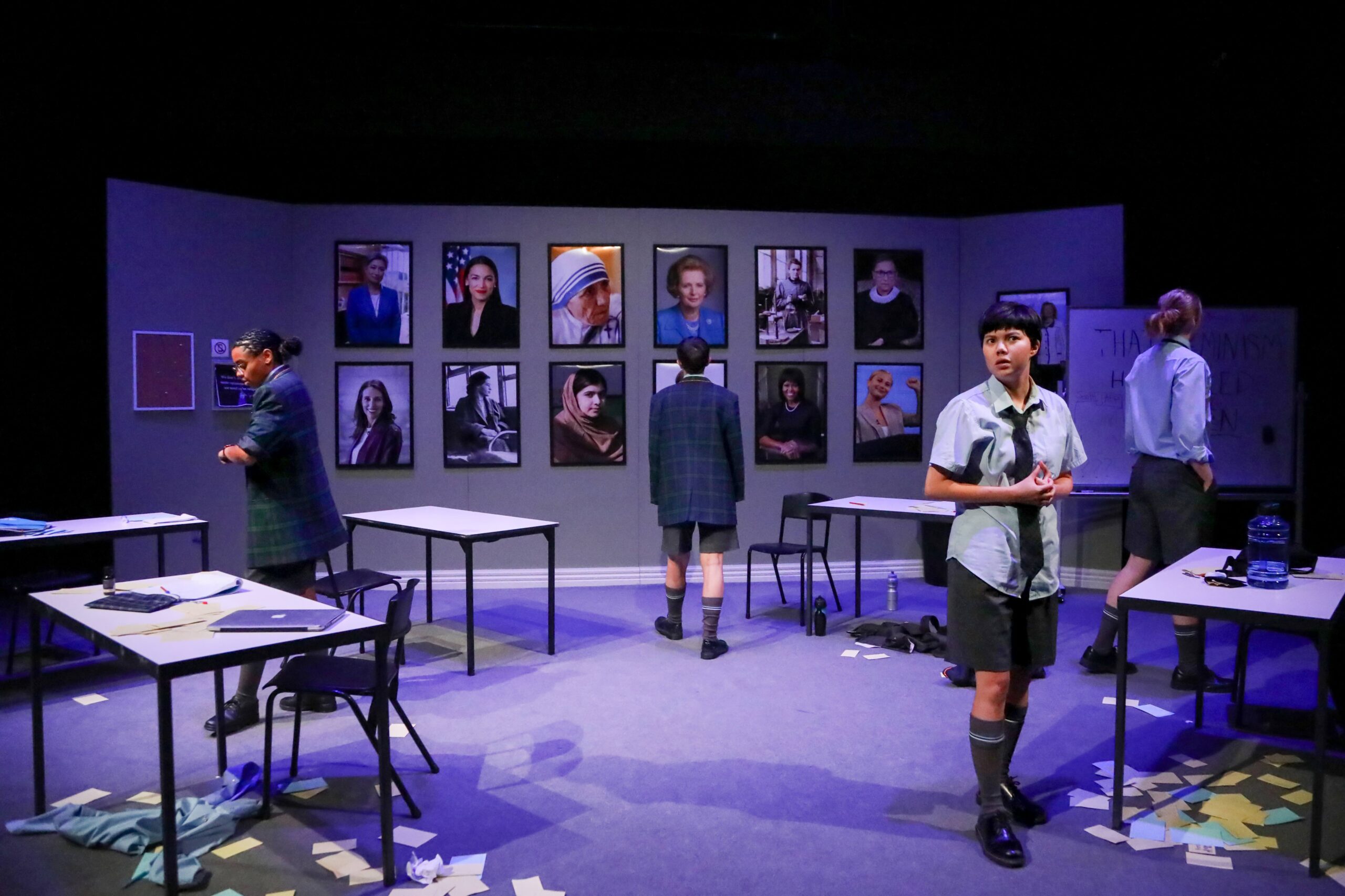
Trophy Boys, written by Emmanuelle Mattana and directed by Marni Mount, is a compelling piece of theatre that explores the undercurrent of rape culture that permeates boys’ schools and perpetuates misogynistic attitudes – even among those who claim their respect for women.
Set in a high school debate room, four boys from the undefeated St Imperium College debate team are preparing their argument for the finals. Their assigned position: “Feminism has failed women. Affirmative.” Adding a comedic and satirical spin is the casting of characters played by female and non-binary identifying actors in drag. What is not satirical is their incredibly realistic portrayal of teenage boys’ mannerisms, and their representations of attitudes towards women, minorities, sexuality, and masculinity held by boys grappling with their sense of entitlement at a crucial stage of their development. The play makes incredibly prevalent commentary on how rape culture festers beneath the surface of a performative respect for women, exposing the many ways it can manifest in these boys’ interactions with each other and the women in their life.
Every element of this production works in harmony to create exactly what theatre should be: entertaining whilst being extremely relevant to our social climate. The show was written in response to the historic rape allegation made against former Attorney-General Christian Porter from when he was 17 at an interstate debating tournament, and based on Mattana’s own experience of high school debating. It is through this that Trophy Boys was born, to satirise the toxic elite private school culture, and make comment on the performance of masculinity: how it is learned, and how it is used to maintain power.
The show is set in a classroom, where the only pictures on the walls are of notable women of history. These women bear witness to these boys as they break down feminism, their masculinity, and slowly reveal the poisonous environment that they operate within. The set is a thematic representation of the enclosed world these boys inhabit; a world in which harmful ideologies are permitted to form because they are protected from external scrutiny. It is through recreating this closed space that the show can expose the boys’ attitudes for what they are: misguided and misogynistic.
The decision to place every actor in drag cuts the tension of the show in a refreshing way, without diminishing its message. The casting functions on multiple levels simultaneously. On the surface, it is hilarious and camp, drawing its audience in before a significant tonal shift. Beneath the humour lies something far more pointed. By having women and non-binary performers step inside the skin of these boys, the production shows that this culture is not invisible – it has been seen, studied, and understood from the outside. In this way, the casting feels like an act of reclamation as opposed to ridicule, with those most affected by toxic masculinity the ones holding up the mirror. While drag keeps the tone light enough to be accessible, it carries with it a sense of accountability. The black comedy does not let these attitudes off the hook; it exposes them. By the show’s end, the comedy gives way to an acknowledgement that this culture exists, and that we recognise its patterns. With tasteful wit and exceptionally intelligent writing, Trophy Boys insists that the conversation around this culture must be shared and documented through art, showing us that there are so many ways of delivering a powerful message.
The acting in the play is superb. There was an attention to detail in nailing the boys’ mannerisms, such as constantly manspreading, or imitating the tone with which boys tease one another. Each character brought something distinct to the stage, and though these actors were imitating male characters, there was no depth lost to how their rich personal and emotional lives revealed themselves over the course of the show. Myfanwy Hocking played a convincing Owen, the unofficial leader and aspiring politician who presents as the most respectful member of the group. Hocking slowly reveals Owen’s true character in such a fantastically subtle way that you only realise the signs once everything has transpired. Kidaan Zelleke is equally strong as the quietest member of the team, effectively capturing how feelings of inadequacy and defensiveness manifests in the actions of their characte. Tahlia Jameson plays Scott, a boy desperate to embody his perception of the ideal “bloke”, fighting a potential attraction to his best friend while working to be the coolest and loudest in the room. Jameson sustains a compelling performance of your archetypal rugby boy while simultaneously letting Scott’s internal conflict reveal through the facade. Fran Sweeney-Nash plays a confident and loud Jared, an aspiring artist preoccupied with his own image, and his popularity with girls. Sweeney-Nash does an incredible job of nailing his intolerable characteristics and ego, whilst managing to make him a somewhat likeable character, despite his obvious flaws. What tied all these performances together as an ensemble was that none of the actors lost the depth of the character by over-committing to the bit, all of them presented their characters with authenticity.
Trophy Boys is such a vital production to be performing right now, and should be a mandatory watch for all teenagers, parents, teachers, coaches – anyone collectively tasked with recognising toxic thoughts and behaviours, and doing the work to change them.