Review by Freya Rowell
Star-Crossed Lovers with a Star-Studded Soundtrack
Free-Rain Theatre Company
The Q – Queanbeyan Performing Arts Centre
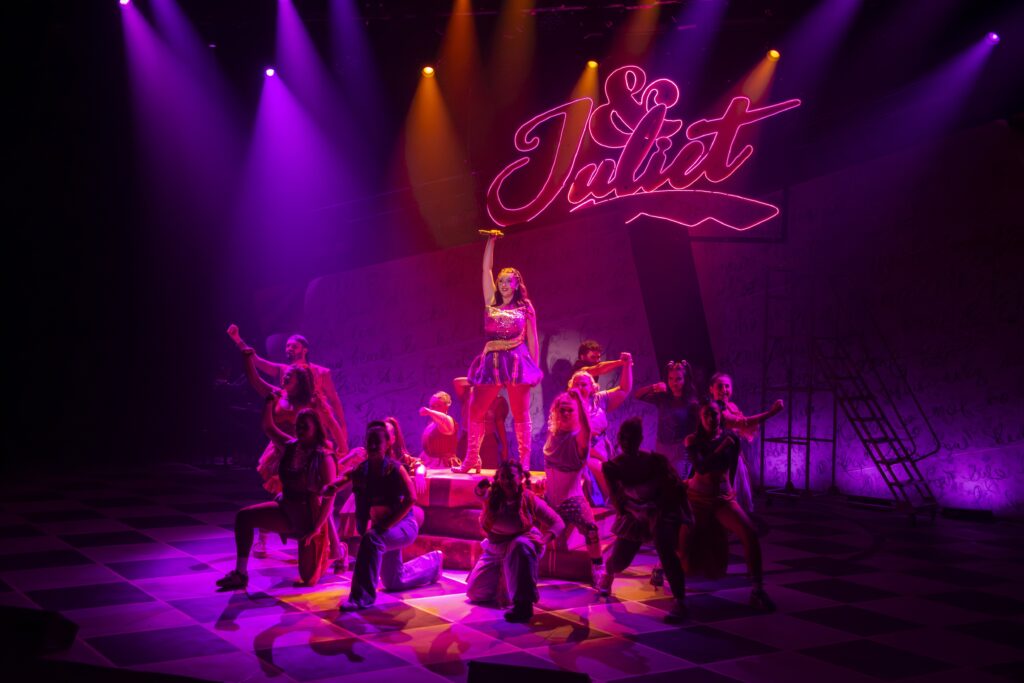
We open on the first ever performance of Romeo and Juliet. William Shakespeare recounts his tale of love-struck teenagers to his wife Anne Hathaway, ending with the lovers’ tragic double suicide. But Anne Hathaway wants to see a new story, and seizing his quill begins to pen a version where Juliet chooses life. What follows is a tug-of-war over the story, with Shakespeare scheming for Juliet to unite with a man and Hathaway vicariously insisting Juliet will be a strong independent woman. Such is the premise of & Juliet, Free Rain Theatre Company’s most recent glitter-soaked musical production.
& Juliet’s soundtrack consists of pop songs by Max Martin: the most famous songwriter you have never heard of. Including songs made famous by Britney Spears, Katy Perry, Backstreet Boys and NSYNC among many others, the show provides a cross-section of popular music across the 1990s, 2000s and 2010s. & Juliet is intentional in its use of Martin’s songs. By using several songs transformatively the show avoids a common weakness of unoriginal jukebox musicals. Juliet prays for “a sign” and laments “how was [she] supposed to know” while processing Romeo’s death in …Baby One More Time, and the Capulets demand she “surrender [her] heart, body and soul” intending to send her to a convent in Show Me The Meaning of Being Lonely. Even the songs that are shamelessly shoe-horned in, such as the family band breaking into Everybody (Backstreet’s Back), are so much fun it is difficult to remain cynical. Perhaps the best transformed song is that sung by Hathaway’s original character May, a best friend for Juliet to compensate for Romeo’s friends in Benvolio and Mercutio. May is a transfemme non binary character (hilariously named for NSYNC’s highly meme-able pronunciation of It’s Gonna Be Me). They sing Britney Spears’ coming of age ballad I’m Not a Girl, Not Yet a Woman to describe their pain after being intentionally misgendered and their struggles with identity. The reframing of the song, sung sweetly by Joshua Kirk, is a thoughtful piece of representation for the genderqueer community, and timely given the show premiered on Trans Day of Visibility (31 March).
Martin’s catchy songs are made infectious by the high energy and tight harmonies of Free Rain’s ensemble as directed by Charlotte Morphett and James Tolhurst-Close. The entire cast of 23 commit so strongly to the material that audience members are dancing in their seats, and their earnest delivery saves the majority of songs from becoming corny (although it is hard not to cringe when Shakespeare delivers “I want Anne Hathaway” to the tune of I Want It That Way). The set, also designed by Morphett and Tolhurst-Close, immediately establishes the meta style of the show with large books, a jukebox and the letters of “Romeo” strewn haphazardly about the stage to explain the fragmented show title. The costumes are a highlight of the production design. Costume designer Fiona Leach creates a patchwork of corsets and pantaloons with denim and cargo pants to embody the meeting old and new between the source material and music.
An unusual choice in Free Rain’s production is the cast’s accents. With the exception of William Shakespeare and Lance, the cast all use American accents, including Anne Hathaway. If it were only when singing this could be put down to reproducing the American pop hits, but there seems to be no reason for a troupe of English actors performing a play set in Italy and France to be speaking in the accent of a country not yet founded in Shakespeare’s time. This seems to demonstrate a pervasive view that general American is the default accent in musical theatre, particularly when the show was produced in the UK long before it reached Broadway.
The show is advertised as a bold and empowering take on the bard’s tale of woe. While it does explore themes of Juliet’s agency and self-identity, there are many parts of the text it refuses to engage with. Surely, if the star-crossed lovers do not take their life, then their parents’ strife would not be buried as in Shakespeare’s famous prologue, and the bloody Montague-Capulet grudgematch would continue. Rather than address this, the script by Schitt’s Creek writer David West Read decides to simply relocate Juliet and her friends via a roadtrip to Paris, with little mention of the fallout in Verona. A subtler, potentially more interesting theme in the play is that of conflict. As Shakespeare and Hathaway fight over Juliet’s story, Shakespeare is constantly stirring the pot, insisting that any story must have conflict, whereas Anne, whose sad life viewers will be newly familiar with due to the recent success of Hamnet, begs him to keep it light and write a happy story unlike the one she is living. The concept of all stories requiring conflict is a standard Western narrative taught in writing at all levels, but is not universally agreed upon. Anne Hathaway asks in & Juliet whether, particularly in times of hardship, all stories must have conflict and sorrow to be important.
If one is searching for a cerebral feminist analysis of Romeo and Juliet, this show will leave you wanting. However, if you are open to an evening of belting and partying to fun songs while considering stories and who gets to tell them, & Juliet will prove a real treat.