Review by Ekatarina Maric
An Exploration of Mental Illness & Autonomy in The Almighty Sometimes
Off The Ledge Theatre
The Q – Queanbeyan Performing Arts Centre
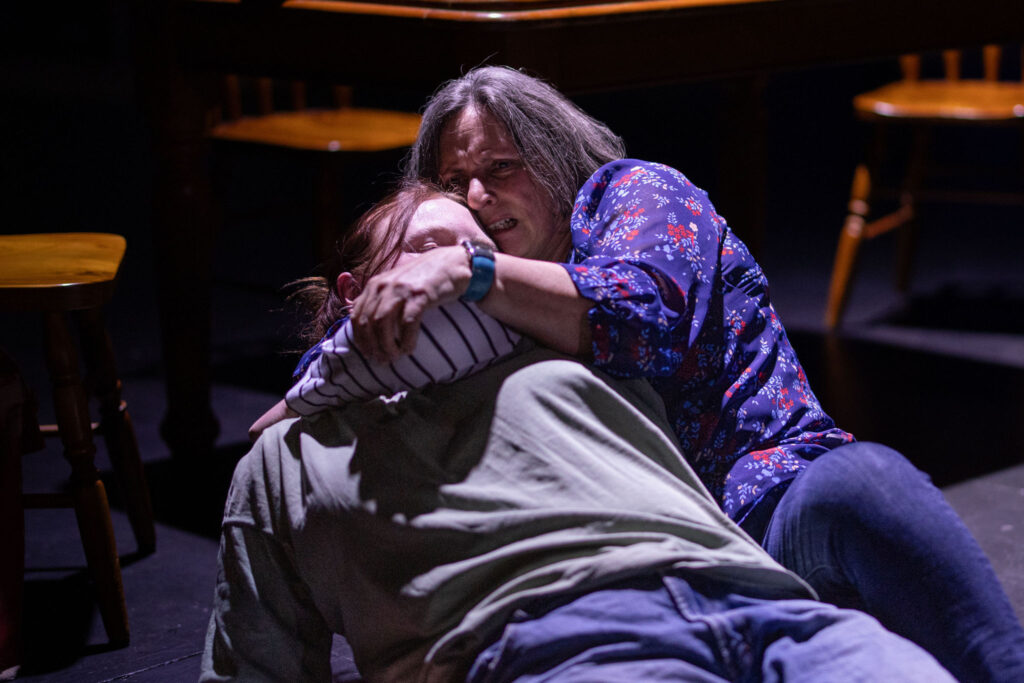
At 8, Anna was a writer and self dubbed ‘prodigy’, unaware that her disturbing stories were being used as diagnostic tools for her doctors. At 11, she was prescribed pill after pill, her problems having only become worse. Now, at 18, Anna does not know where the drugs end and she begins. Feeling blocked and frustrated, she ceases taking her medication against all advice. This serves only to exacerbate ‘The Illness’, which remains unnamed but haunts every interaction that plays out on stage, ready to jump out from the wings when Anna declares herself stable. Though she begins the play a talkative (if not over excitable and socially struggling) girl, she descends into full blown mania. We watch her retreat, become silent, then cruel, explosive, and finally, reach a tired equilibrium.
The Almighty Sometimes (written by Kendall Feaver and directed by Lachlan Houen) is unique in its portrayal of mental illness. Throughout the show, Anna’s (played by Winsome Ogilvie) illness is never once romanticised. It is not afraid to show the ugliest parts of her reality, and explore moments where she isn’t just sick, but a downright unlikable character. However, Anna is not demonised. As an audience member, you can’t help but empathize with her. Even as she digs into those around her, using their deepest insecurities to hurt them, it’s clear that all she wants is for someone to feel her own pain for just one moment, even if she cannot understand or care about the feelings of others. Her mother, Renee (Elaine Noon), and boyfriend, Oliver (Robert Kjellgren), both struggle in realising that Anna is unable to reciprocate their efforts when all her energy goes towards her own existence. The relationships in this show are messy and fractured, and the dynamics between the characters are not resolved nicely by the end.
At first impression, Anna’s character is written like a cliché. She is introduced with a bubby personality, her dialogue being fast, full of references, and almost too witty- a sitcom teen straight out of a Gilmore Girls episode. I found myself put off, believing that she would be this archetype of character that has been seen before a million times. However, as the script expands Anna outside of her initial cliché, I had to rethink my first impression. It becomes clear that she is a girl who doesn’t know how to hide anything she feels or hold anything back, being the bubbly behaviour or a complete social shutdown. This arc is artfully portrayed by Winsome Ogilvie. She breathed life into Anna with tics and ‘odd’ behaviours that made her stick out from everyone around her. Her ability to swing from 0 (Anna in a catatonic state, refusing to speak or move) to 10 (screaming, crawling desperately around the stage) in a manner of seconds brought much tension and even dread to the show.
Importantly, The Almighty Sometimes doesn’t shy away from the topic of autonomy. Anna wants nothing more than to make her own decisions, move away on her own, stop her meds without needing to follow someone’s orders, and the people in her life can never give her this. As Anna’s mother, Elaine Noon shows the deeply sad reality of never being able to offer her daughter the same freedom other people her age have. Rather than mother-daughter hugs, we see Renee restrain Anna to keep her from harming herself. Noon’s performance in these high stakes moments, as well as the ‘normal’ parts of their life, brought a deep exhaustion and determination to her character.
Despite the acting and storyline flowing well, several production issues undermined the shows effectiveness. There was occasionally a musical accompaniment under the dialogue, but this was so rare and often jarring that it felt like an afterthought. These seemingly random piano notes served only to take the audience out of the world of the play, as they introduced tonal shifts that weren’t in line with what was happening in the scene. Along with this, the production wasn’t well adapted to the space it was in. Most of the action took place at a fixed point centre stage, leaving much unused space and drawing out dramatic moments as the actor had to cross for so long. Combined with the lighting that remained up on the empty space, these choices diffused focus and made it difficult as an audience to fully engage with the scenes.
The Almighty Sometimes has a lot to say about complexities of mental illness- how it affects those who are sick, and those who are supporting someone sick. This is an honest and tragic story, though I found that elements of this production served to take me out of the story rather than immerse me further. Despite this, I enjoyed the actors performances, and appreciated the conversations that the play’s topic was able to spark. I am still left wondering what the right path would be; giving Anna her right to freedom as an adult, or acting in her better interest?

Ekatarina Maric is a passionate writer and theatre goer, aiming to experience all the Canberra theatre scene has to offer. Before graduating, she participated in her high school’s performing arts program as much as possible, including putting on shows that she had written whilst also performing in the cast. Post graduation, she hopes to continue participating in programs such as Canberra Youth Theatre’s Young Critics, and expand her experience in all areas of theatre. She especially loves shows put on and performed by young people, and adores musical theatre.