Review by Mili Fisher
The Good Boy Game; fun to watch, but not to play.
Caitlin Baker / Q The Locals
The Q – Queanbeyan Performing Arts Centre
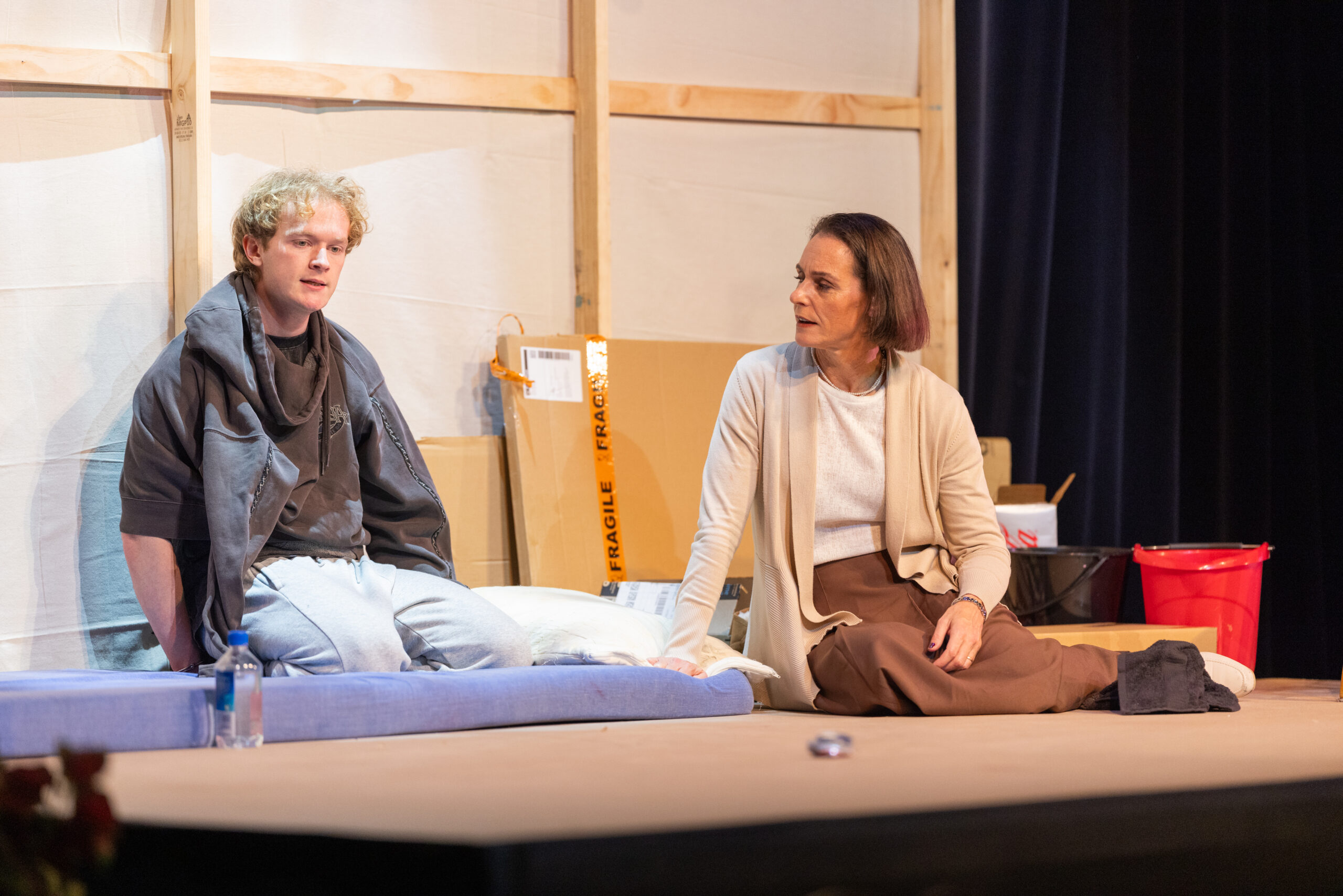
You know you are watching something of worth when the audience collectively experiences a stomach-churn so intense that it elicits an audible reaction throughout the theatre. In Patrick Vermillion’s The Good Boy Game, directed by Caitlin Baker as a part of the 2026 season of Q the Locals, this was the moment where the reward system of ‘good boy’ points became less about learning manners and more about controlling violent fantasies.
The story begins in the moments after Sam (Bruce Hardie) and Mary-Beth (Giuliana Baggoley) find their son, James’ (Alastair McKenzie) notebook full of his plans to conduct a school shooting. As she confronts James about his plan, Mary-Beth introduces a reward system, in which she handcuffs him in the attic, promising his release on the condition that he earns two million ‘good boy’ points. Points are earned from various behaviours deemed desirable by Mary-Beth, and it is in this grey area of motherly subjectivity that problems begin to arise.
From the moment the audience enters the theatre, they are greeted with the set of a warm and cosy home. Bathed in soft, warm light is a dining room, an attic on a raised platform, and a separate room which we later discover to be a therapy office. Additionally, characters are already on stage, moving about silently but conversing with each other, as if we have simply stumbled into their world.
Though the play begins with an Adolescence-esque commentary on the way society influences violence in children, it slowly takes a turn towards darker and much more disturbing themes of incestuous fantasies born out of co-dependent relationships. Mary-Beth is determined to prove that James’ violence is just a product of external influence, and that he remains inherently good. However, the question is of her motive; to help better her son or to prove her own innocence in his behaviour? Mary-Beth begins to accommodate for some of James’ vile behaviours as she becomes more desperate for her reward system to succeed, but in doing so she validates his darkest desires and the pair fall deeper into dysfunctionality. In this, the play begins to speak on the dangers of indulging toxic masculinity, and the role we may unknowingly (or knowingly) play in enabling similar behaviours.
The production did a superb job at putting the audience in discomfort as a way to drill this message through. The discomfort was amplified most notably by the performance of Alastair McKenzie as James. McKenzie’s ability to switch so seamlessly between the manipulatory self-pitying ‘woe is me’ act and the enraged toxic male brought an unpredictable tension to his character that created fear of his actions and the potential he has to cause harm. With Giuliana Baggoley playing Mary-Beth opposite McKenzie, the stage remained in a state of anxiety and unease, both actors alive and utterly convincing in their performances. Additionally, Bruce Hardie and Elaine Noon, playing Mary-Beth’s therapist, allow the madness of McKenzie and Baggoley’s characters to shine even brighter.
Despite its American setting and central issue of gun violence, Baker’s director’s note affirms the relevance of this production on the grounds that the underlying themes conveyed are closer to home than we think. Her point being that deluding ourselves into believing they only exist oceans away will only lead to their growth. Baker’s claim that “there is a danger in believing we can tolerate our way out of hate” sums up the underlying messaging of the production, and confirms its service to an Australian audience.
The Good Boy Game certainly elicits distress and unease in the face of disturbing and violent fantasies. However, the audience leaves the theatre forced to question themselves; are these really just fantasies or has The Good Boy Game simply managed to hold a mirror to society?