Review by Freya Rowell
Misogyny Gives Way to Madness in The Good Boy Game
Caitlin Baker / Q The Locals
The Q – Queanbeyan Performing Arts Centre
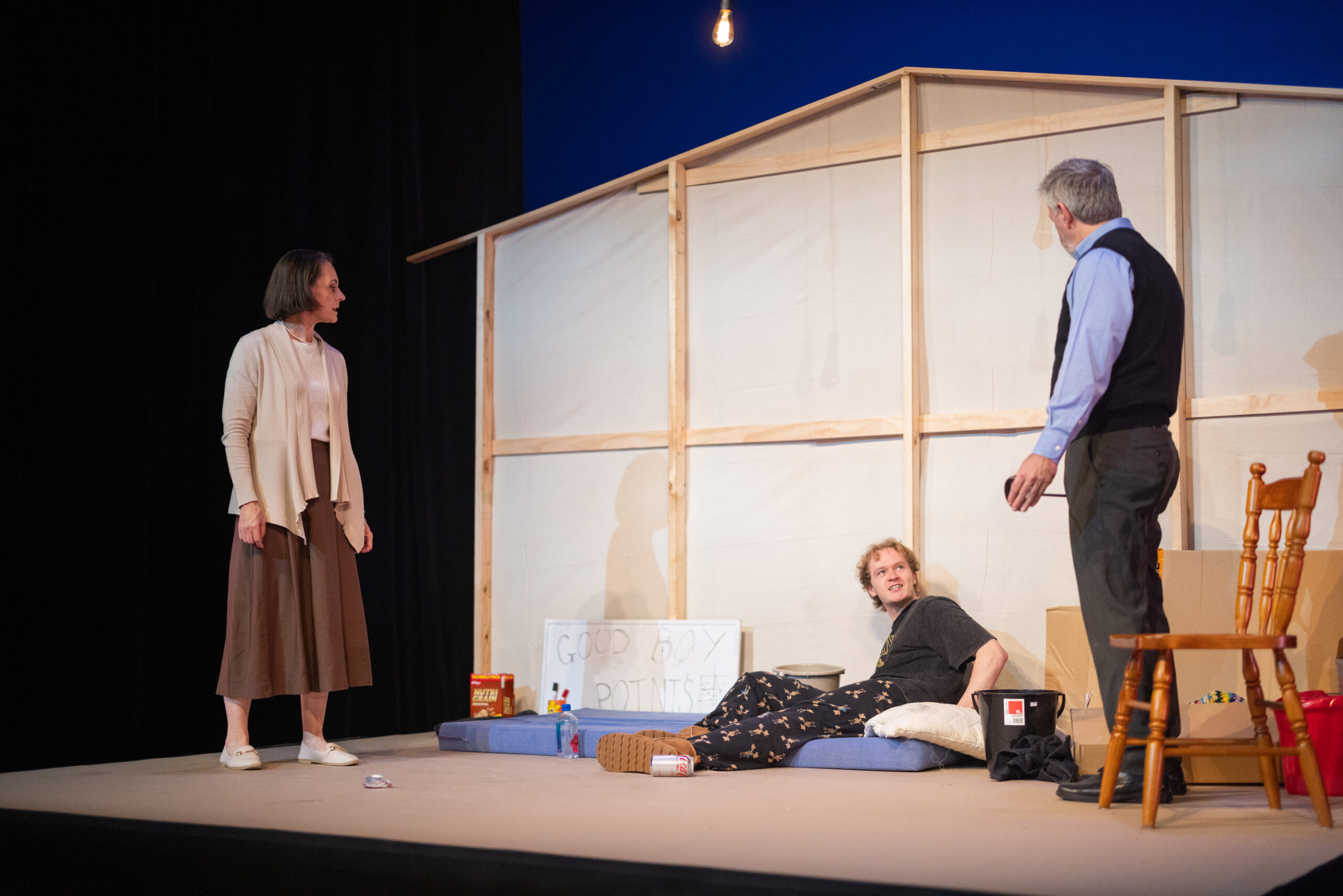
The world premiere of The Good Boy Game by Patrick Vermillion performing at The Q has promoted itself as “a furious, darkly funny deep-dive into radicalisation [and] masculinity”. Despite its undoubtedly skilled cast and keen direction from Caitlin Baker, the play undercuts its exploration of the Manosphere in favour of a simpler anxiety.
Punctuated by a grungy guitar sting, the show opens with a gun and a notebook. Concerned parents Mary-Beth (Giuliana Baggoley) and Sam (Bruce Hardie) read their teenage son’s plan to commit a mass shooting. Rather than call the police, sending their baby boy away and tarnishing their reputations as left-wing anti-gun academics, the couple opt to handcuff James (Alastair McKenzie) in the attic. Using a system suggested by Mary-Beth’s therapist (Elaine Noon), who is unaware of James’ more violent tendencies, they start rewarding positive behaviour with “Good Boy Points” which he can trade in for Diet Coke and chicken nuggets like tickets at an arcade.
Mary-Beth searches for any possible external reason for James’ lashing out: lackluster parenting, the internet, bullies, anything that is traumatic “in the right way”. Meanwhile her husband suggests that maybe their son is just evil, a genetically pre-disposed psychopath. When a more pertinent psychological issue is revealed later in the play, it becomes increasingly difficult to disagree with Sam. While James insists the internet has helped him articulate his view that women are destroying Western civilisation, it seems this is almost a trendy veneer to cover his even darker desires.
Baggoley and McKenzie are compelling as the fraught mother-son duo. Mary-Beth’s persistent determination to bring out the good in James, while the teenager callously insists that there is none to be found, creates moments of shocking comedy and disturbing drama. Hardie and Noon round out the cast well, including tense head-to-heads between the two men and the two women. The set is simple but effective, with pristine furniture contrasting the clinical therapist’s office with the years of detritus in James’ attic prison. The lighting and sound, designed by Lachlan Houen and Neville Pye (in collaboration with Baker), work together to extend the tension, allowing the audience to stew in their discomfort.
Baker’s director’s notes state that The Good Boy Game warns against coddling radicalised people. This is present in the show. We are led to roll our eyes as the therapist pitches the points system as a way for young men to internalise the praise they once received in abundance for merely lifting a finger around the house. James’ father demands recognition for all the times he didn’t commit mass murder during times of stress. Mary-Beth’s unending desire to prove her son really is a “good boy” brings out the darkest parts of both her and James. But nevertheless the show’s heightened twist ultimately undermines its red-pill setup, while simultaneously riding the coat tails of media like Adolescence and Obsession.
The Good Boy Game succeeds as a deeply unsettling psychological thriller, but falls short of the biting interrogation of modern masculinity promised.